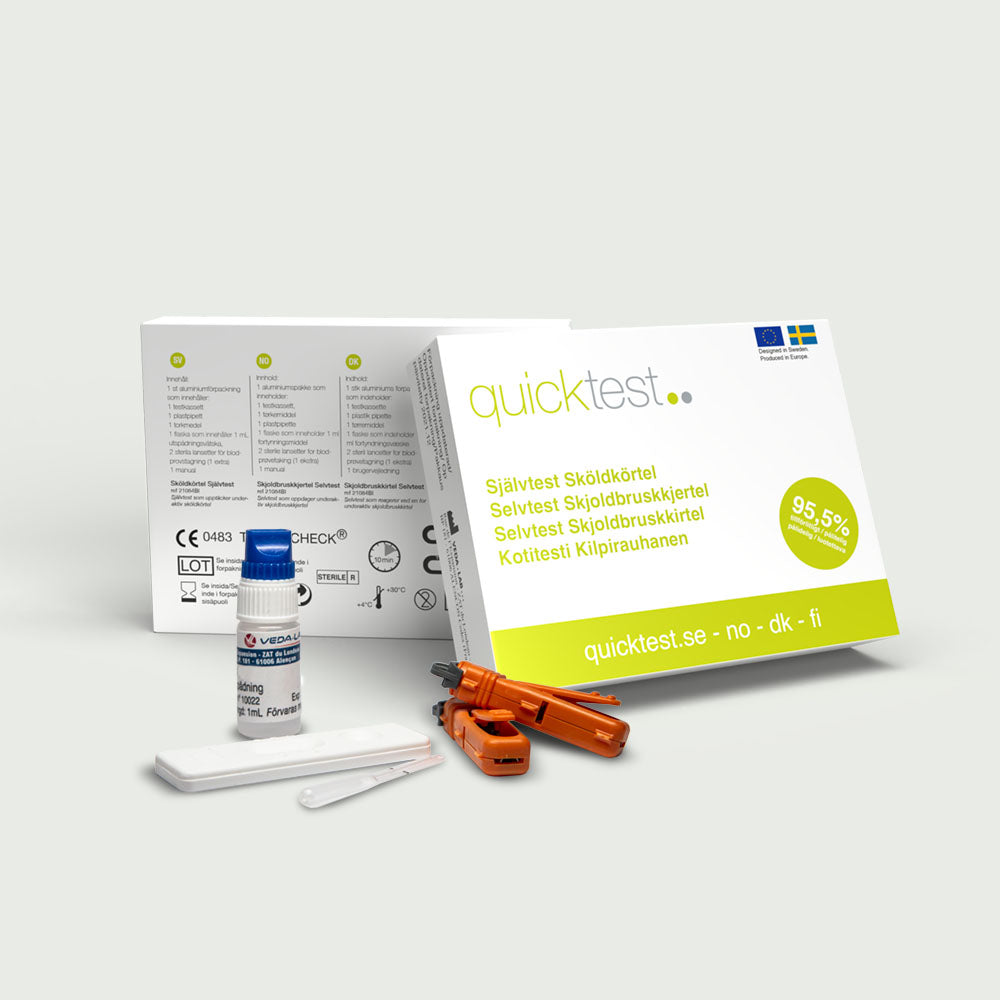
Thyroid test
Self-test
Blood You perform the test yourself and receive the result immediately.

Thyroid test

149 DKK
  • Sveriges mest sålda
  • Svar inom 5 minuter
  • Detta test finns på Apotek
  • 100 % nöjd kundgaranti
  • Enkelt & säkert
  • Direkt i brevlådan

Buy more, save more

Payment methods
  • MobilePay
  • Klarna
  • Visa
  • Mastercard
  • Apple Pay
  • Google Pay
In stock and ready to ship

Test at a glance

Take the test at home and get a clear result immediately.

Test type
Self-test
Sample
Blood
Results within
10 min
Reliability
95.5%

Thyroid test

95.5% reliable - Made in Europe - over 50,000 tests sold - do the test at home & get results instantly! How is your thyroid? Do you feel tired, hungover, dizzy or lack energy, maybe you have difficulty losing weight? Your friends and family have perhaps noticed that you have changed? It could be due to an imbalance in your thyroid. Then you are not alone - it is one of our most common diseases. Our test can give you answers to why you feel the way you do. If your thyroid is underactive, it affects the level of the hormone TSH in your blood. Previously, these tests could only be done at a health center, but thanks to new technology, you can now check yourself and get answers in a few minutes. Our European-made thyroid test is easy to do with a simple and painless prick of your finger. In just a few minutes, you will receive a reliable and clear message whether you have an underactive thyroid. The test shows positive when the TSH level is higher than 5μIU/ml. Click on “Watch Video” below to see how easy it is to test. The thyroid test from Quicktest is very safe and reliable, and it is also CE markedThe technology has been used in healthcare for about 10 years to quickly and easily detect changes in thyroid function in patients. More information about how Quicktest's thyroid test works can be found in the manual. Why should I test myself? It can be difficult to detect a thyroid disease based on its symptoms alone, as the most common symptoms are very general. However, with a thyroid test, you will get a clear message about whether your weight fluctuations/fatigue/listlessness/dizziness are due to a thyroid disorder or not. This means that you can more easily seek care and get the right treatment, which is important as some thyroid diseases can cause serious complications. Are the tests really safe? Yes absolutely. 90% of our production is for professional healthcare and various laboratories, our self-tests actually only originate from these and are basically the same. An important thing that distinguishes them is that the manuals for our self-tests are greatly simplified and thus adapted for those without medical training. However, the same strict requirements are placed on function, safety, reliability and EU directives for IVD tests. So you get a self-test that meets the same strict requirements as healthcare tests. How common is it to do self-tests? It's common and becoming more common. We've sent out over 50,000 tests, just in Sweden. Many people have actually received help after they've performed a self-test and received a positive result. Always take a photo of a positive result, it can be good information for your doctor. How safe and reliable are your self-tests compared to taking tests at a health center? Our tests are reliable, however, it is important to understand how the tests work and what distinguishes them from, for example, laboratory tests. Simply put, it works like this: There are different types of self-tests, regardless of the type of test, a body fluid is required; some require blood, some urine, saliva and certain secretions from, for example, the vagina. When the body fluid comes into contact with the test, a reaction occurs and a result is displayed - positive or negative. A test that shows a positive or negative result is called a qualitative test, so you get a yes or no. The tests are "pre-programmed" with a so-called cut-off value, if the result is above or below a predetermined value, the test shows positive. The cut-off value is determined by the WHO (World Health Organization). A laboratory test gives a quantitative answer, i.e. you get a value. Our tests therefore give a positive or negative based on a limit value set by WHO. A laboratory gives a value, e.g. 5.6 ng/ml ferritin. Our test would have, in this case, instead shown positive. The laboratory gives an exact answer. Should your self-tests be used to make a diagnosis? No. Our tests are not used to make a diagnosis, they are used to give an indication. It is always a doctor who makes a diagnosis, this is often done after various tests and clinical examinations. Why should I use a self-test? There are many answers to that question. Most of our customers feel that our tests have resulted in them finally receiving help from primary care, when a test indicates that something is not right, many feel that it is easier for them to get the help they are actually entitled to. Therefore, always take a photo of the result if it is positive and take it to the doctor. How do you guarantee security/reliability? By following all the directives required for CE marking. This means, among other things, that we have ensured that manuals etc. are easy to understand - even for those without medical training. Our tests are also manufactured in Europe, which gives consumers extra security as the regulations for these tests are extensive. Publication information Fact-checked 2025-01-08 by Leg Doctor Fredrik Lönnqvist Leg Nurse

What is analysed

  • Specific TSH hormone level

How it works

From sample collection to a clear result – every step is designed to be simple.
01

Open the test

02

Collect the blood sample

03

Start the test

04

Read your result

Fredrik Lönnqvist

The doctor’s view

It is worth noting that this self-test indicates an underactive thyroid, which is by far the most common type of thyroid disorder. Figures suggest that around 600,000 people in Sweden suffer from this condition, so it is undeniably widespread. Fortunately, it is relatively easy to treat with medication.

The symptoms are very general, which makes the condition difficult to detect without testing. Common symptoms include fatigue, weight gain, dry skin, anxiety-like symptoms, low mood and general unease.

Fredrik Lönnquist

Licensed Physician

Fredrik Lönnqvist
Licensed physician
Video

Frequently asked questions

How do you know if you have hypothyroidism?
In hypothyroidism, hormone production is reduced, resulting in a low metabolic rate that in the early stages causes nonspecific symptoms such as fatigue, feeling cold and depression. Some people have a general feeling that something is wrong. More symptoms may develop over time, including dry skin, hair loss, constipation, weight gain, memory difficulties, a low heart rate, swelling of the face, and joint and muscle pain.
What causes hypothyroidism?
Low levels of thyroid hormone can have several causes. Thyroid diseases can be related to inherited genes. In most cases, hypothyroidism is caused by chronic inflammation of the thyroid gland. For unclear reasons, the body then forms antibodies that damage the thyroid. Pregnancy and menopause can also affect how the thyroid produces hormones; production can both increase and decrease. Iodine intake is also considered an important factor. The thyroid needs iodine to produce hormones, so iodine deficiency can cause hypothyroidism. In rare cases, children can be born with reduced thyroid function.
Can men have thyroid problems?
Yes. However, hypothyroidism, or an underactive thyroid, is ten times more common in women than in men.
Can hypothyroidism make it harder to become pregnant?
The thyroid plays a role in fertility, especially in women, although men can also be affected. Untreated hypothyroidism often reduces fertility in women, which can make it more difficult to become pregnant.
How does your thyroid test compare with testing at a healthcare center?
Our tests are reliable, but it is important to understand how they work and how they differ from, for example, laboratory tests. Put simply: A laboratory test gives a quantitative result, meaning you receive a value such as 7.4 μIU/ml. Our tests are 'pre-programmed' with a threshold value and show a positive or negative result, so you receive a yes or no. Our tests therefore provide a qualitative result. If the result is above the predefined value, our test is positive; if it is below, it is negative. The threshold is determined by the WHO (World Health Organization). Our thyroid test is positive when the TSH level is higher than 5 μIU/ml.
Should your self-tests be used to diagnose hypothyroidism?
No. Our tests are not used to make a diagnosis; they are used to provide an indication. A diagnosis is always made by a doctor, often after various tests and clinical examinations.
Why should I use your thyroid test?
There are many answers to that question. Most of our customers feel that our tests have helped them finally receive assistance from primary care. When a test indicates that something may not be right, many people find it easier to get the care they are entitled to. Therefore, always take a photo of a positive result and bring it to your doctor.
How do you ensure safety/reliability?
By following all directives required for CE marking. This means, among other things, that we have ensured manuals and other materials are easy to understand, even for people without medical training. Our tests are also manufactured in Europe, which provides extra reassurance for consumers because the regulations governing these tests are extensive.
Portrait

Home testing made simple

Quicktest brings together self-tests and home sampling tests in one place. Clear instructions, discreet delivery and easy-to-understand results help you take the next step with confidence.

Portrait
100.000+
Customers and users
Quality
Carefully selected tests
Europe
Delivery across Europe
Support
Help choosing the right test
Thyroid test